
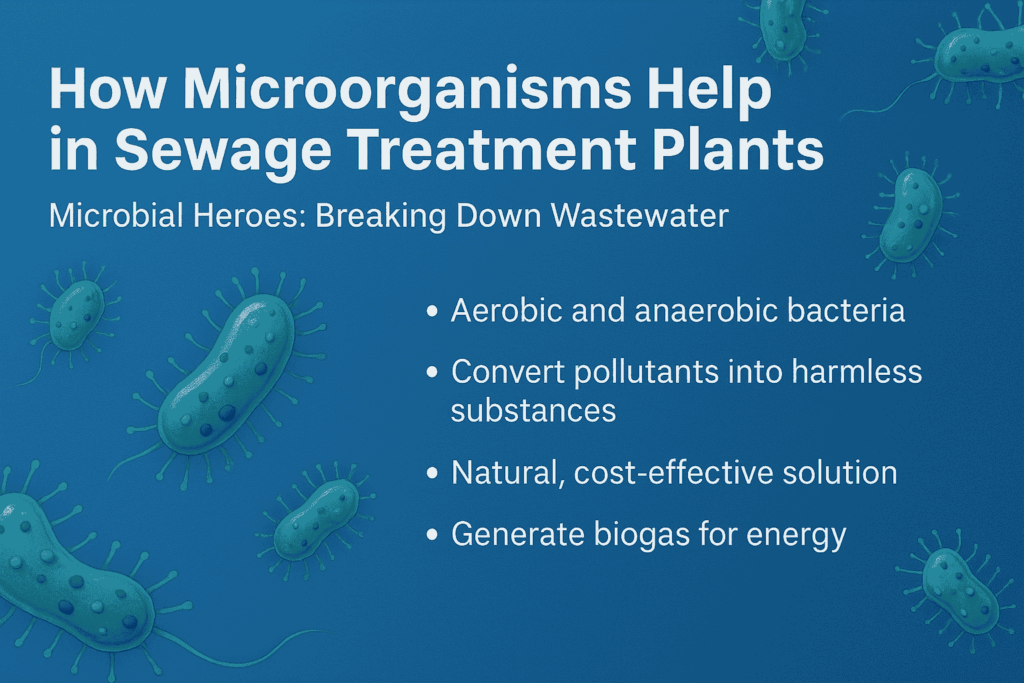
When we talk about sewage treatment, the image that often comes to mind is one of huge industrial machines, spinning turbines, and complex filtration systems. However, while mechanical systems are certainly important, they are not the real superheroes behind clean water. Surprisingly, the unsung champions of sewage treatment are microorganisms—tiny living organisms invisible to the human eye, yet immensely powerful in their function. These microscopic life forms work tirelessly to treat and purify our wastewater every day.
Microorganisms: Nature’s Clean-Up Crew
Microorganisms such as bacteria, protozoa, fungi, and algae play a central role in waste water purification. They are nature’s own clean-up crew, capable of breaking down complex waste materials and converting them into simpler, harmless by-products like carbon dioxide, water, and biomass.
Their job is to consume the organic matter present in sewage, such as human waste, food particles, oils, soaps, and detergents. In the process, they detoxify the water, making it safe for disposal or reuse. Without these tiny workers, the entire concept of sewage treatment would collapse.
How Microorganisms Work in Sewage Treatment
Microorganisms function best in controlled environments like Sewage Treatment Plants (STPs), which are designed to simulate natural conditions where these microbes thrive. Depending on the presence or absence of oxygen, two primary types of bacteria are used:
1. Aerobic Bacteria
Aerobic bacteria need oxygen to survive. These microbes are typically used in Activated Sludge Processes, Trickling Filters, and Rotating Biological Contactors (RBCs). In these systems, oxygen is pumped into the treatment tanks to encourage microbial growth and activity. The aerobic bacteria then consume organic pollutants and convert them into carbon dioxide, nitrates, water, and new microbial cells (biomass).
This process is highly effective and commonly used in urban treatment plants due to its fast action and ability to handle large volumes of sewage.
2. Anaerobic Bacteria
In contrast, anaerobic bacteria do not require oxygen. These microbes thrive in sealed tanks or digesters where no oxygen is present. Anaerobic digestion breaks down organic waste through fermentation and other biological processes, producing methane gas and carbon dioxide as by-products.
The methane gas generated is not just a waste product—it is a valuable biofuel that can be captured and used to generate electricity or heat, thereby powering parts of the treatment plant itself. This makes anaerobic treatment highly sustainable and energy-efficient, especially in rural or industrial applications.
Why Microbial Treatment Is So Effective
The use of microorganisms in sewage treatment offers a range of economic, environmental, and operational advantages:
✅ Natural and Sustainable
Microorganisms are part of Earth’s natural ecosystem. They reproduce quickly and can adapt to various environmental conditions. This makes them a renewable and self-sustaining solution for waste water management.
✅ Cost-Effective
Because microbes do the heavy lifting, chemical usage is minimized. This not only reduces operational costs but also eliminates the risk of chemical contamination in the treated water.
✅ High Efficiency
Well-maintained biological systems can remove up to 95% of organic waste, making the treated water safe for reuse in agriculture, landscaping, or industrial processes.
✅ Energy Generation
Anaerobic systems offer the added advantage of biogas production, which contributes to a plant’s energy self-sufficiency. This is particularly valuable in regions with unreliable power supplies.
✅ Eco-Friendly Outcome
Unlike chemical treatment, biological processes do not leave behind harmful residues or by-products. This ensures that the discharged water is safe for the environment, preserving aquatic ecosystems and public health.
Application in Jammu & J&K
The importance of microbial sewage treatment becomes even more evident in developing and ecologically sensitive regions like Jammu and Kashmir (J&K). With growing urbanization, tourism, and industrial activity, the volume of sewage and waste water is on the rise.
Implementing low-cost, decentralized biological treatment systems is a smart and scalable solution for towns, rural clusters, and smaller industries across the state. These systems require less land, are easier to maintain, and are perfectly suited to handle variable loads of sewage.
Local Solutions by Vishwamitra Water Technologies
Leading the way in microbial-based STP systems in the region is Vishwamitra Water Technologies, based in Jammu. The company specializes in customized sewage treatment plants that harness the power of microorganisms to provide clean, reliable, and eco-friendly solutions. Whether it’s a residential colony, hospital, hotel, or industrial setup, their designs are tailored to suit the specific needs of each client while ensuring compliance with Pollution Control Board standards.
The Future of Sewage Treatment Is Microbial
By leveraging the natural capabilities of microbes, we are not only cleaning waste water more effectively, but we’re also creating a system that is circular, green, and future-ready. It allows us to reduce dependence on chemicals, cut operational costs, and produce useful by-products like biogas and nutrient-rich sludge that can be used as fertilizer.
Conclusion
In the grand scheme of sewage treatment, microorganisms are the silent heroes working behind the scenes. Their ability to digest, neutralize, and transform organic waste makes them indispensable to the waste water management industry.
As cities and towns across Jammu and Kashmir look to modernize their sanitation infrastructure, adopting biological treatment methods is a step in the right direction. With support from expert providers like Vishwamitra Water Technologies, these natural clean-up crews can help us build a cleaner, greener, and more sustainable future—one drop at a time.